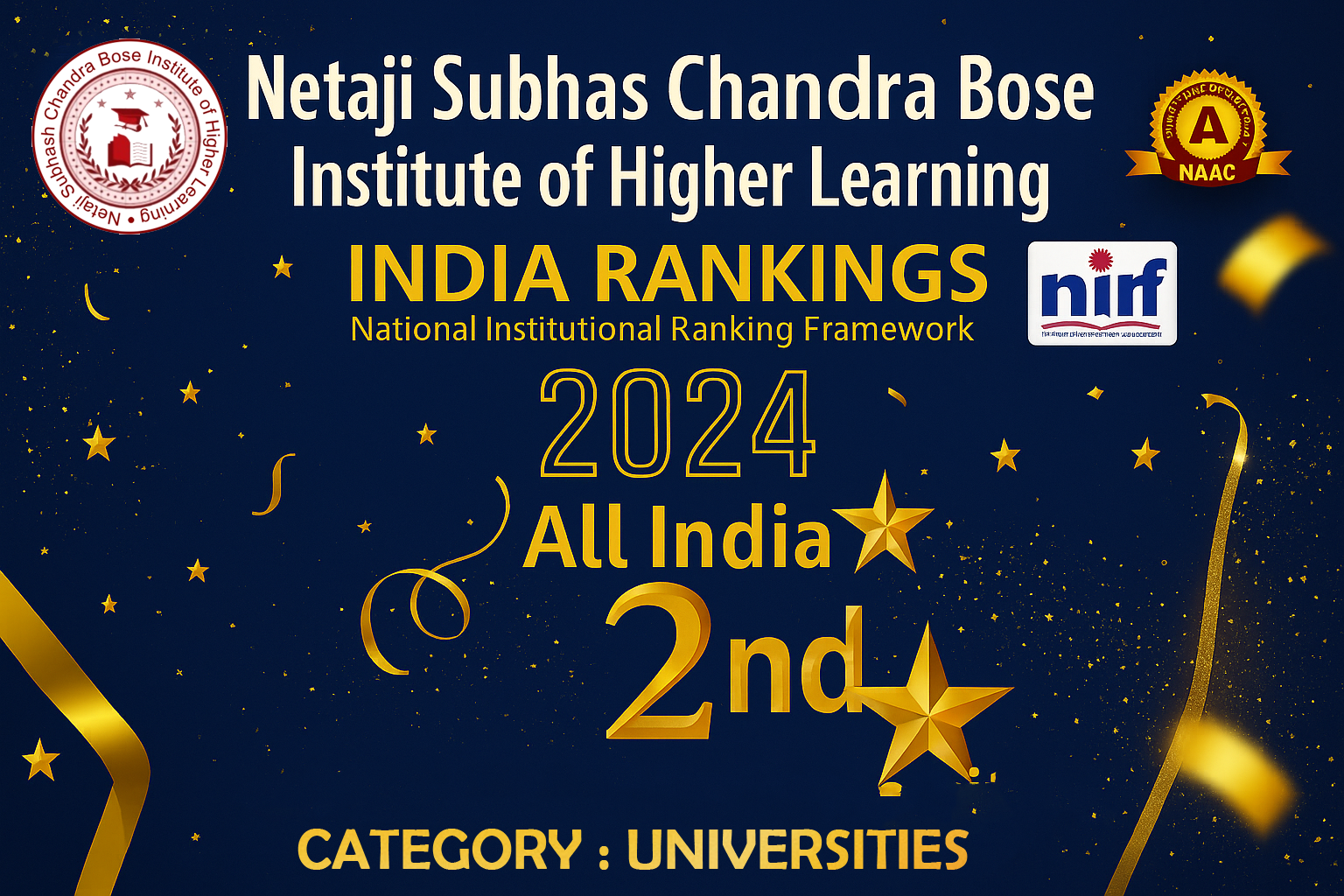
Netaji Subhash Chandra Bose Institute of Higher Learning is a multi-disciplinary, research-intensive, Deemed to be University educating a vibrant student population of over 18,000 by 900+ strong faculty. Accredited with the highest possible ‘A++’ grade by NAAC, NSCBI offers more than 250 UG, PG, and Ph.D. programs in Engineering, Management, and Medical Sciences including Ayurveda, Life Sciences, Physical Sciences, Agriculture Sciences, Arts & Humanities, and Social & Behavioral Sciences.
With its extensive network of three campuses spread across Chennai, Vishakhapatnam and Kolkata, Netaji Subhash Chandra Bose Institute of Higher Learning stands as one of India’s preeminent educational institutions. Encompassing an expansive area of over 800 acres, these campuses offer an impressive built-up space of more than 60 lakh square feet. Renowned for its commitment to academic excellence, Netaji Subhash Chandra Bose Institute of Higher Learning consistently ranks among the top-tier universities in the nation, solidifying its reputation as a beacon of quality education.
In THE University Impact Rankings 2023, a pioneering initiative to recognize universities around the world for their social and economic impact for sustainable future, NSCBI has been ranked among the Top 50 in the world. NSCBI is emerging as one of the fastest-growing institutions of higher learning in India as we have established 180+ collaborations with top 300 world-ranked universities in a short span.
Our vision is to be an exemplary institution that thrives on its commitment to the transformative power of value-based education, providing the impetus to develop the expansiveness to harmonize both scientific knowledge and spiritual understanding, to utilize knowledge for societal benefit and contribute to a prosperous and sustainable future for all.
NSCBI profound mission of providing education for life, and emphasis on compassion driven research, has shaped NSCBI as a unique institution:
There are two types of education: education for living and education for life. Studying to become a professional is education for a living, while education for life requires an understanding of the essential human values. At NSCBI, we believe that education should also impart a culture of the heart, based on enduring values and inner strength. NSCBI’s culture of education helps to inculcate in our students the right ethos to be rooted in the values of Dharma (righteousness), Karuna (compassion), and Shraddha (mindfulness). Endowed with qualities of acceptance, patience, self-confidence, perseverance, and enthusiasm, the benefit of humanity will become foremost in the students’ thoughts, words and actions. They will then pioneer innovative solutions for the benefit of all humankind, leading to sustainable health and prosperity for all. This resonates with the ancient Sanskrit prayer ‘Lokah Samastah Sukhino Bhavantu’. It is a reminder of our deeper connection to the entire world around us, “May our work contribute to the happiness of all beings.”
Our motivation to pursue research is focused on alleviating major global problems related to poverty, starvation, sickness, environmental pollution, and contamination. We believe that if we could transform compassion from a mere word into a path of action, we would be able to address most of the world’s problems. If we take this step courageously, then our research and its outcome will have a special impact, spontaneity, and power. This has translated into many latest advancements and innovations that have culminated in greater societal benefit.
At NSCBI, we stand united in our mission towards solving globally recognized scientific and societal challenges, including environment, development, and health. NSCBI stands at the strategic juncture of two streams of cultures: East and West. It is our vision to bring both cultures together to bridge the division through meaningful collaborations with world-class universities and innovative approaches that will benefit the entire planet.
Nestled in the heart of Chennai, a thriving center for research, education, and technological advancement, stands a dynamic institution at the forefront of the tech city. The 50 acres’ campus, featuring green laws and the burgeoning trees, is well connected by road, rail and air. The campus offers Science, Humanities, Management, B. Tech. programs in five disciplines and M. Tech. programs in six disciplines. The school seeks to prepare graduates with a solution-mindset and with a high degree of ethical standards. Departments are equipped with modern laboratories, design tools and software packages. vision to produce quality engineers with an attitude of service, for the benefit of the society and nation.
To be a global leader in the delivery of engineering education, transforming individuals to become creative, innovative, and socially responsible contributors in their professions.
Each academic day at NSCBI starts with the chanting of the prayer. This brings on a positive mind set for the students, teaching fraternity and other associated entities and paves way for an environment susceptible for learning and growing into better beings.
Shubh jyotsana pulkit yaamini
Phulla kusumita drumadal shobhini
Shubh jyotsana pulkit yaamini
Phulla kusumita drumadul shobhini
Suhasini sumadhur bhashini
Sukhdam vardam mataram.
Vande mataram, vande mataram – (4)
Saptkoti kunth kal kal ninaad karle
Disaptkoti bhujairdhut khar karwale
Saptkoti kunth kal kal ninaad karle
Disaptkoti bhujairdhut khar karwale
Abala keno maa eto bole
Bahubal dhaarini namaami taarini
Ripudal vaarini mataram.
Vande mataram, vande mataram – (4)
Tumi bidya tumi dharma
Tumi hrṛdi tumi marma
Tbaṃ hi pranaḥ sarire.
Bahute tumi ma sakti,
Hṛdaye tumi ma bhakti,
Tomarai pratima gaṛi mandire mandire.
Vande Mataram Vande Mataram – (4)
Tvam hee durga dashapraharanadharini, kamala kamaladala viharini
Vani vidyadayini, namami tvam
Namami kamalam amalam atulam sujalam suphalam mataram
Shyamalam saralam susmitam bhushhitam, dharinim bharanim mataram, vande mataram.
Vande mataram – (4)” “vande mataram
Sujlaam sufaam
malyaj sheetlam
Shasya shyamlam
mataram!”